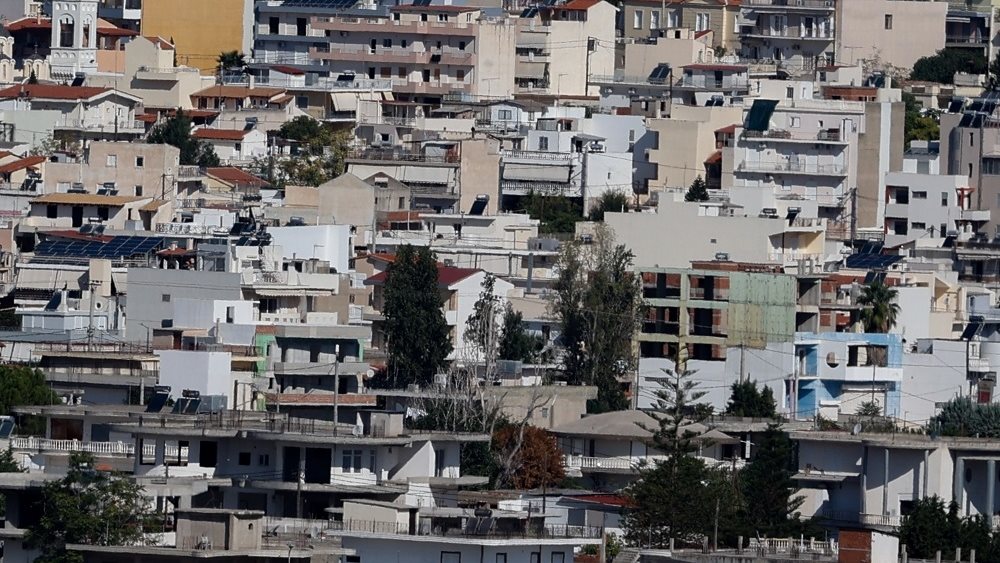
Land values for building plots across Attica have reached their highest level in a decade after rising for a seventh consecutive year, according to the latest Geoaxis Value Observatory for the second quarter of 2026.
The report found that asking prices increased by an average of 4.21 percent compared with 2025 and 48.08 percent over the past decade. While annual growth has slowed from 5.60 percent in the previous reporting period, Geoaxis says the market remains resilient and may be approaching the peak of its current cycle rather than entering a downturn.
Seven years of rising land values
All five local markets tracked by the observatory recorded higher asking prices over the past year, extending a seven-year upward trend.
Palaio Faliro posted the strongest annual increase, with median asking prices rising 5.07 percent to 1,703 euros per square meter. Ampelokipoi followed with a 4.68 percent increase to 2,727 euros per square meter, while Cholargos (4.17 percent, 1,350 euros/sq.m.), Marousi (3.96 percent, 972 euros/sq.m.), and Peristeri (3.21 percent, 998 euros/sq.m.) also recorded gains.
Over the full decade, Ampelokipoi registered the strongest cumulative increase at 54.34 percent, while Peristeri recorded the smallest rise at 41.60 percent.

Geoaxis noted that the figures reflect median asking prices for typical plots. Land with premium features, such as prime location, views or larger size, can command prices up to 25 percent higher.
Geoaxis noted that the figures reflect median asking prices for typical plots. Land with premium features, such as prime location, views or larger size, can command prices up to 25 percent higher.

At the same time, undeveloped plots of 1,000 square meters or more have become increasingly scarce across Attica.
Demand continues to support prices
Despite moderating growth, Geoaxis expects land values to continue rising over the next 12 months, albeit at a slower pace.
The report dismisses concerns of a real estate bubble, arguing that demand continues to be supported by a shortage of land for new residential developments and strong demand for newly built homes.
According to the observatory, the market continues to benefit from accumulated housing demand following the economic crisis, high liquidity, changing work patterns such as remote working, the aging housing stock built before 1980, and sustained investor interest in residential property for both rental income and portfolio diversification.
Construction costs and regulation remain key challenges

Geoaxis cautions that rising construction and financing costs are making negotiations between developers and landowners increasingly difficult.
Borrowing costs currently range between 4.5 percent and 5.5 percent, while construction costs have risen by around 10 percent in recent months, partly due to geopolitical tensions and disruptions affecting global supply chains.
The report also identifies uncertainty surrounding land-for-apartment exchange rates (antiparochi in Greek), the recovery of land values in the Northern Suburbs, and the implementation of Greece’s revised New Building Code (NOK) as key factors that could influence the market over the coming year.
Although the tighter planning framework presents short-term challenges for developers and buyers, Geoaxis believes it will ultimately contribute to greater stability and transparency in the construction sector.
Meanwhile, data from the Hellenic Statistical Authority (ELSTAT) show that building permits declined 2.6 percent in 2025 compared with the previous year, while construction material costs increased 2.6 percent in the 12 months to February 2026, down from 5.3 percent in the preceding 12-month period.